





Health & Wellbeing · 14 October 2026 · 4 min read
Rest days that actually make you stronger
Recovery is training too. How to use Stretch classes, walks and sleep.

Here is a sentence that sounds like an excuse and is actually physiology: you do not get stronger during exercise. Classes create the stimulus. The adaptation, the actual building of stronger muscle and better movement, happens afterwards, during the unglamorous hours of eating, walking around and sleeping.
Which means rest days are not the gaps between your training. They are half of your training. Most people run that half terribly, either by doing nothing at all and stiffening like old rope, or by refusing rest entirely until their body files a formal complaint. Here is how to do it well.
What is actually happening between classes
A good Reformer class leaves your muscles with microscopic damage and your nervous system with new information. In the day or two afterwards, your body repairs the tissue slightly stronger than before, restocks its energy stores, and consolidates the movement patterns you practised. That process is the entire point of exercising, and it has requirements: time, food, sleep, and gentle circulation to move nutrients in and waste out.
Train hard again before the process finishes and you interrupt the construction. Do it occasionally and no harm done. Make it a lifestyle and you get the plateau, the persistent soreness, the third cold this term, the nagging niggles. Coaches call it under recovering, and it quietly caps more people's progress than lack of effort ever does.
Deep soreness after your early classes, incidentally, is this process being new, not broken. It settles as your body gets practised at repair.
Active beats inactive
The tempting version of rest is the couch, and the couch is fine for part of it. But full stillness is actually slow recovery. Muscles repair faster with blood moving through them, joints feel better lubricated by motion, and a body that only ever trains hard or lies still never learns the middle gear.
The gold standard is active recovery: easy, low load movement that raises circulation without adding new training stress. Living in the Illawarra, you are embarrassingly well supplied for this. A flat walk along the water at Wollongong or Shellharbour, an easy swim, an unhurried bike ride, floor time playing with kids or dogs. Twenty to forty minutes of any of it, at a pace where conversation is easy, and your recovery is measurably ahead of the couch only version.
The timetable's built in recovery gear
Here is the part of our own timetable people underuse for months: two of the six class styles are recovery assets, designed to be trained on the days between harder sessions.
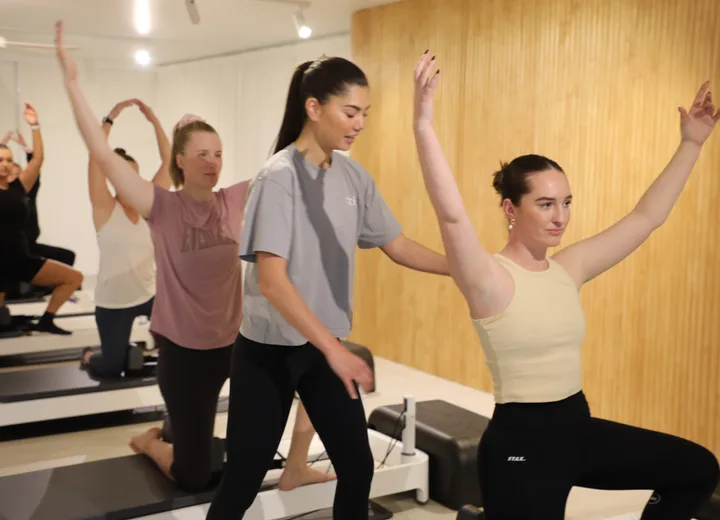
Stretch classes are the flagship. Long holds, deep release, a slower pace aimed at unwinding tight hips, shoulders and backs. Booking Stretch the day after a Tempo or Jump class is the single best scheduling trick on our timetable, and the members who guard a weekly Stretch spot are, not coincidentally, the ones whose hard classes keep improving. The flexibility gains are a bonus on top.
Yoga does similar work with a different flavour, adding balance and breath, and calming the nervous system, which is itself a recovery organ. A stressed system recovers slowly no matter what the muscles want, and the breathwork threaded through every class is as useful on rest days as training days.
A gentle Control class can also serve as recovery for experienced members, movement quality without meaningful load. Effort has a dial, and rest days are for the low numbers.
Sleep and food, briefly and honestly
No supplement conversation required. The two recovery tools that dwarf everything else are unglamorous.
Sleep is where the majority of repair happens, and members who fix a chronic six hour habit routinely notice their training transform within weeks, something we explore in Pilates for better sleep. Aim for the boring seven to nine.
Food wise, recovery days are for normal, adequate eating: enough protein through the day for the repair work, enough carbohydrate to restock, plenty of water. The specifics live in our guide to eating around classes. Restricting hard on rest days because you "did not earn it" is one of the more common ways people quietly sabotage their own progress. The construction crew needs materials most on the days after the demolition.
A week that breathes
Put together, a strong sustainable week has a wave shape rather than a flat line. Something like: Flow on Monday, an easy walk Tuesday, Jump on Wednesday, Stretch or Yoga Thursday, Flow again Saturday, and a genuinely lazy Sunday. Effort, ease, effort, ease. The exact classes matter less than the rhythm, and our frequency guide covers how many total sessions fit different lives.
The sign you have the balance right is simple: you arrive at most classes feeling capable, not flogged, and you leave them energised more often than emptied.
Rest like you mean it
If you have been training hard and progressing slowly, the missing ingredient is probably not another hard class. It is the deliberate easy day between them.
The nice thing is that our timetable stocks both halves of the equation at Wollongong and Shellharbour. Book your Flows and Jumps, then book the Stretch class after them, and treat that booking with the same respect. The 21 day trial, unlimited classes for $65, is a good three week window to practise the full rhythm: work, recover, repeat, improve.