


Moving Well · 29 September 2026 · 5 min read
How to breathe in a Pilates class
Lateral breathing explained simply, and what it does for your core and your calm.
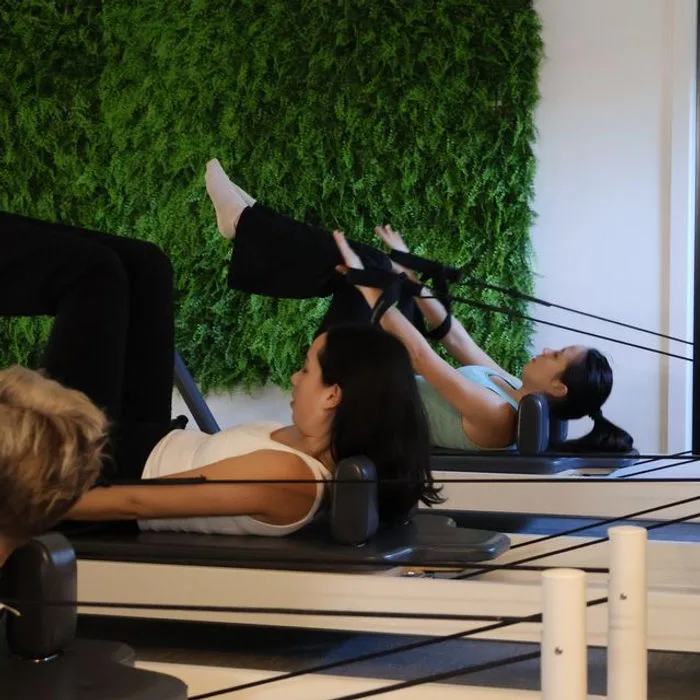
Somewhere in your first Pilates class, mid exercise, your instructor will say "breathe" and you will realise you have not been. Everyone does it. Holding your breath is the body's default response to concentrating hard, and unlearning it turns out to be one of the most useful things Pilates teaches.
Breath was not an afterthought for Joseph Pilates. He built his whole method around it, and modern classes still treat it as a skill to be trained, right alongside strength and control. Here is how it works and why it is worth practising properly.
The style: lateral breathing
Everyday deep breathing tends to be belly breathing. You inhale, your abdomen expands, everything relaxes. Lovely on a yoga mat at the end of the day. Unhelpful mid exercise, because in Pilates your deep abdominal muscles are supposed to stay gently engaged, and you cannot brace your centre and balloon it outwards at the same time.
The solution is lateral breathing, sometimes called ribcage breathing. Instead of sending the breath into your belly, you send it sideways and backwards into your ribs. Your ribcage widens like an umbrella opening, your back expands, and your abdominals stay quietly switched on underneath.
Try it right now. Sit tall, place your hands on the sides of your lower ribs, and breathe so that your hands move apart while your belly stays fairly still. That widening feeling is it. Nobody nails it instantly, which is exactly why it gets practised in class rather than explained once and forgotten.
When to inhale, when to exhale
The general rule in Pilates: exhale on the effort. Pressing the carriage out, curling your spine up, pulling the straps down, that is exhale territory. The inhale usually accompanies the return or the preparation.
There is real mechanics behind this. A steady exhale naturally recruits your deep abdominals and pelvic floor, so timing it with the hardest moment of the exercise gives your spine its best support exactly when the load peaks. It also makes holding your breath impossible, which matters more than people realise. Breath holding spikes pressure and tension through your torso, and strains have a way of happening in those clenched, airless moments.
Do not spiral about getting the timing perfect, though. If you are mid exercise and cannot remember the pattern, the instruction is simple: keep breathing, any pattern at all. A wrong way breath beats a held one every single time. Your instructor calls the breath cues throughout class precisely so you never have to memorise them.
What good breathing changes
More than you would expect for something invisible.
Your endurance improves, because muscles fed a steady supply of oxygen keep working long after clenched, airless muscles have given up. Exercises you thought you lacked strength for often just needed airflow.
Your rhythm improves. Breath gives each movement a tempo, and once you sync with it, transitions smooth out and the whole class starts to feel less like fifty separate exercises and more like one continuous piece of movement. That flow state is a big part of why people describe Pilates as meditative even while their legs are on fire.
Your core connection improves, because the diaphragm is the roof of the core cylinder and the pelvic floor is its base. Every well timed exhale is quietly training both, which is why the breath work pairs so naturally with everything in what core strength actually means.
And your stress response improves. Slow exhales stimulate the calming branch of your nervous system. It is the reason a hard Pilates class can somehow leave you more relaxed than you arrived, and it works just as well in traffic on the Princes Highway as it does on a Reformer.
Learning it without overthinking it
A confession from the teaching side: it is possible to think about breathing so hard that you forget how to do it. New members sometimes tie themselves in knots trying to coordinate breath, movement, springs and form all at once.
So here is the graded approach we actually recommend.
- Weeks one and two: just do not hold your breath. That is the entire goal. Move and breathe, in whatever order happens.
- Weeks three and four: start noticing the instructor's breath cues and catching a few of them, especially the exhale on effort.
- From there: experiment with lateral breathing during the slower exercises, when you have spare attention. Footwork at the start of class is the perfect laboratory.
Control classes are the best place to practise, since the slower pace leaves room to think. By the time you are in Flow and Tempo classes, the breathing will have gone automatic, which was the plan all along.
A skill that leaves the studio with you
Members tell us the breath work shows up everywhere. Before a difficult conversation. In the dentist's chair. Walking up the Bulli pass stairs. Trying to fall asleep, which we cover more in Pilates for better sleep.
That is the quiet gift of the method. You come in to work your body, and somewhere along the way you get handed a portable tool for settling your whole system, free with every class.
If you have been curious about Pilates, breathing is honestly reason enough to start. Book a Control class on our timetable at Wollongong or Shellharbour, and for the first session give yourself one single job: keep the air moving. Everything else builds from there.