




Getting Started · 5 October 2026 · 4 min read
How often should you do Pilates? A realistic guide
What one, two or four classes a week each give you, and how to build the habit.
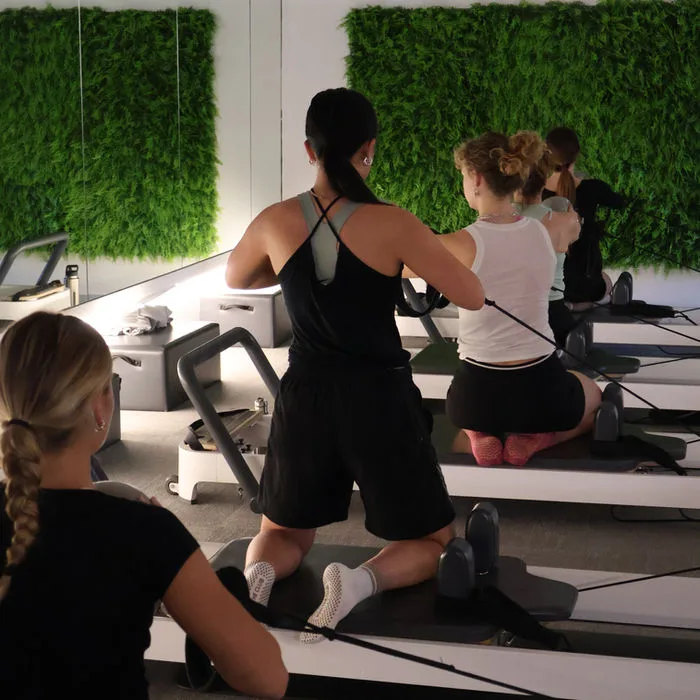
Somewhere between "once when I remember" and "every day like my favourite influencer" sits the right Pilates frequency for you. The honest answer, as usual, depends on your goals and your actual life, so here is a realistic guide to what different frequencies deliver, built from ten years of watching what works for real members with real calendars.
The short version we give in the studio: two to three sessions a week, mixing studio classes with some movement at home. Now the longer version, including what to do when life disagrees.
Once a week: the honest floor
One class a week is genuinely worthwhile, and we will defend it against every purist. You keep your technique, you get 45 minutes of coached, concentrated movement, and you hold a baseline that makes returning to more always easy. For busy seasons of life, the weekly non negotiable class is a solid strategy.
What once a week does slowly is transform. Your body adapts between sessions, and seven days is long enough for some of each week's adaptation to fade before the next deposit. Members training weekly tend to feel maintained rather than changed. If that is the current goal, perfect. If you are waiting for the changes people rave about, this frequency will test your patience.
Make the single class count: Flow gives you the most complete workout per session, and consistency of the same weekly slot beats a floating booking you renegotiate every Sunday.
Two to three times a week: where change lives
This is the frequency we actually suggest, and the research on strength and motor learning agrees with the studio observation: adaptations compound when the next session lands before the last one has fully faded.
At two or three classes a week, results arrive on the timeline people hope for. Expect your thinking about your body to shift almost immediately, noticeable changes in your abdominals somewhere around ten sessions, and posture and strength changes others start commenting on within a couple of months. This is also the frequency where technique becomes automatic, which unlocks the faster classes and makes everything more fun.
A well balanced week at this level mixes intentions. Perhaps Flow plus Control, or Flow plus Jump with a Stretch when your body asks. The six class styles exist precisely so this frequency never gets monotonous, and our guide to picking your class mix maps the combinations.
Practically, this is the 2 Classes a Week membership or, for the flexible, Unlimited. Both cover Wollongong and Shellharbour, which makes fitting classes around a working week far easier, since the two timetables effectively merge into one.
Four or more: for the devoted
Daily or near daily Pilates is lovely if your life allows it, with one condition: variety. Six hard Tempo classes in a row is not devotion, it is a repetitive strain plan. Bodies grow during recovery, not during effort, a principle we explore in rest days that actually make you stronger.
High frequency members should let the timetable breathe for them. Harder sessions alternate with Control, Stretch and Yoga, so the week waves between effort and restoration. Done that way, frequent practice is sustainable for years, and our Unlimited members prove it, some of them training most mornings at 5:45 before the Illawarra has finished waking up.
What actually beats frequency: regularity
Here is the observation a decade of memberships has drummed into us. The member who does two classes every single week, through winter and school terms and busy periods, will outpace the member who does five classes in motivated bursts separated by vanished months. It is not close.
Bodies compound consistency the way savings accounts compound deposits. Small and regular wins. So the most useful question is not "how often is ideal" but "how often can I sustain through my worst month". Pick that number, book those classes as standing appointments, and let ideal take care of itself later.
A few tactics that help it stick:
- Book the same slots weekly, and treat them like meetings that cannot be moved.
- Anchor classes to existing routines. Before work at 5:45, or straight after school drop off.
- Use both studios. A membership that works at Keira Street and Benson Avenue doubles your chances of a class fitting the day.
- Book with a friend. Cancelling on a timetable is easy. Cancelling on Sarah is not.
And when life does interrupt, cancel properly, at least two hours before class, so a waitlisted member gets your spot. Then rebook immediately. The gap that follows a missed class is where habits go to die, and the fastest rescue is a booking already sitting in the app.
Starting from zero
If you are new, resist the enthusiasm spike. Week one soreness is real, and two classes with recovery days between them will serve you better than four heroic sessions and a lost fortnight. Build to three once the soreness pattern settles, usually within a few weeks.
The 21 day trial is the ideal laboratory: unlimited classes for three weeks at $65, which lets you discover your natural sustainable frequency by experiment rather than theory. Most people come out of it knowing exactly what their week wants to hold.
However often you come, we will be pleased to see you. Twice a week, consistently, and future you will be very pleased indeed.