


Moving Well · 7 October 2026 · 5 min read
Why footwork starts almost every reformer class
The quiet warm-up that sets up your knees, hips and ankles for everything after.
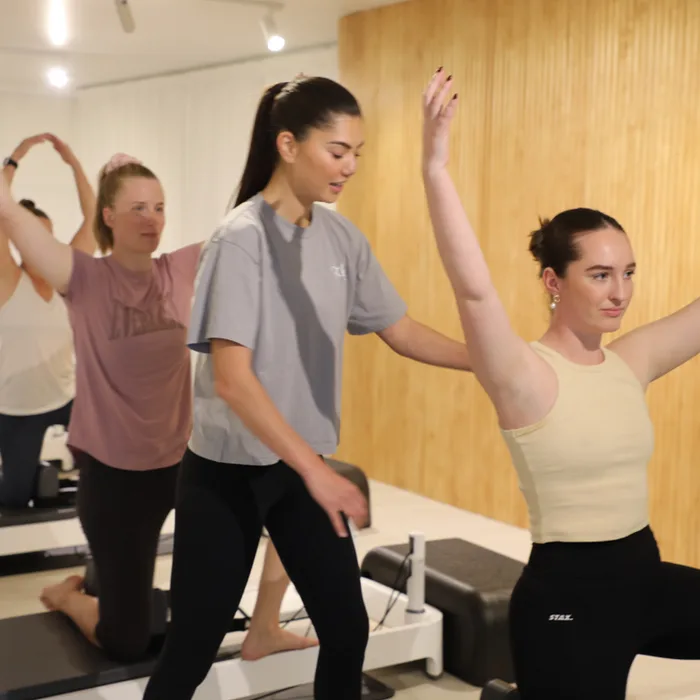
Lie on the carriage, feet on the bar, press out, return, repeat. Footwork is how nearly every Reformer class on earth begins, ours included, and to a new member it can look almost too simple to matter. Pressing a moving bed with your feet, while lying down. This is exercise?
Stay with it a few weeks and the penny drops: footwork is quietly one of the smartest openings in all of fitness, doing about five jobs at once while looking like a warm up. Here is what is actually happening in those first minutes, and why instructors treat them with such respect.
Job one: a safe, honest warm up
The mechanical purpose is obvious enough. Pressing the carriage out and controlling it home takes your ankles, knees and hips through repeated, rhythmic movement against gentle spring resistance. Blood moves, joints lubricate, muscles warm, and it all happens with your spine fully supported and the load starting light.
Compare that with warm ups that involve bouncing around on a cold body, and the appeal is clear. Footwork wakes the biggest muscles in your body, the quads, hamstrings and glutes, without asking your joints to absorb a single impact. It is a warm up a physio could love, suitable for the twenty year old athlete and the seventy year old retiree on neighbouring machines, just with different springs.
Job two: a conversation between you and the machine
Those first presses are also calibration. You feel what today's spring setting means, how the carriage glides, where the resistance bites. After a desk day or a bad sleep, you learn quickly what your body has brought to class, because footwork makes it obvious. Legs heavy? Balance off? One side pushing harder? The opening minutes tell you.
This is part of why the springs stop feeling mysterious so quickly. Footwork is where you meet them, every single class, in the simplest possible movement.
Job three: your instructor's diagnostic window
While you are pressing, your instructor is reading. Footwork shows them almost everything they need to know about how you move today.
Do your knees track over your toes or fall inward? Does one hip do more than its share? Do your feet roll, do your ankles wobble, does your pelvis stay level or rock side to side with each press? Is your lower back staying settled on the carriage or arching up to help?
These small patterns predict how the rest of the class will go, and catching them early means your instructor can adjust cues, springs or exercises before anything harder arrives. In classes as small as ours at Wollongong and Shellharbour, that reading happens for every single person in the room during the opening series. Footwork is when your class quietly becomes your class.
Job four: alignment training in disguise
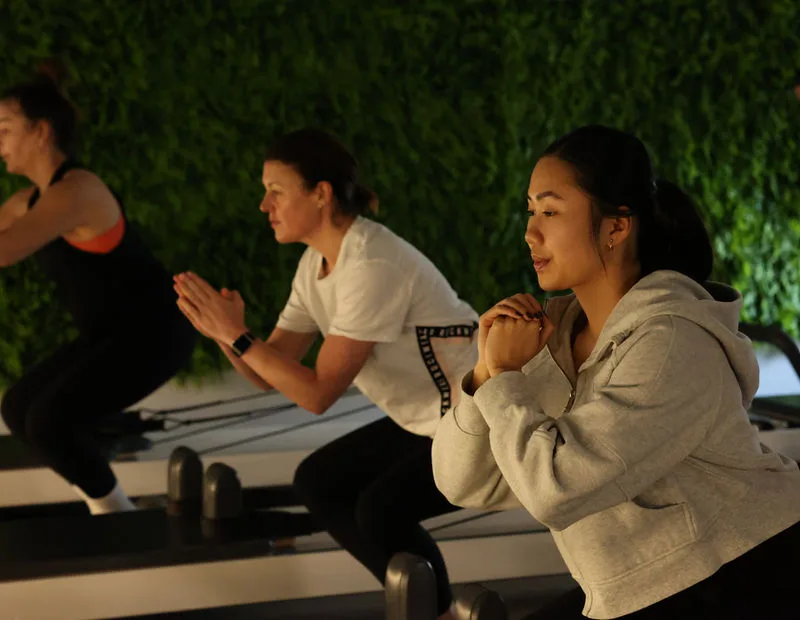
Here is the sneaky one. Every footwork press is a miniature rehearsal of the most fundamental human movement pattern: extending your legs against resistance while your trunk stays organised. It is a supported, horizontal cousin of the squat, and the alignment habits it drills transfer directly.
Knees tracking well over feet. Weight even through both legs. Pelvis stable while the legs produce force. A centre that stays engaged, breathing steadily, as we describe in how to breathe in a Pilates class. Grooved for a few minutes at the start of every class, week after week, these patterns become how your legs simply work, on stairs, on hills, in the garden, getting out of low chairs. Members who came in with clicky knees and collapsing arches often trace their improvement back to nothing fancier than months of attentive footwork.
The different foot positions, toes, arches, heels, wide, narrow, each bias the work slightly differently through your feet, calves and hips, which is why an instructor cycles through them rather than letting you settle into a favourite.
Job five: the mental doorway
There is a rhythm to footwork, press and return, breath matched to movement, that acts as a threshold between your day and your class. Whatever you carried through the studio door, the mortgage, the inbox, the school run logistics, tends to loosen its grip somewhere in that opening series as your attention narrows to the moving carriage.
Members describe it as the moment the class actually starts, and instructors use it deliberately: a settled, focused room moves better and more safely for the next forty minutes. Think of it as the method's built in decompression chamber.
Simple is not the same as basic
Pilates has a habit of hiding sophistication inside plain looking movements, and footwork is the flagship example. Five jobs, done simultaneously, wrapped in an exercise a first timer can perform in their first sixty seconds. It embodies the whole philosophy: precision before intensity, foundations before flourishes, every rep an opportunity to move a little better than the last one, a mindset we explore further in why slow Control classes build the best foundations.
So next class, when you settle onto the carriage and place your feet on the bar, give the opening series your full attention rather than treating it as the ads before the movie. Feel the press, watch your knees, match your breath. The regulars who move beautifully in the hard parts of class are, almost without exception, the ones who take footwork seriously.
And if you have never pressed a carriage at all, the invitation stands: book a Control class through the timetable, and your first footwork series awaits at either studio. It looks like nothing much. It is the beginning of everything.