


Yoga · 5 November 2026 · 5 min read
Breathing in yoga, and how it differs from Pilates
Why yoga teachers ask you to breathe through your nose and into your belly, how that compares with Pilates breathing, and simple practices to try.
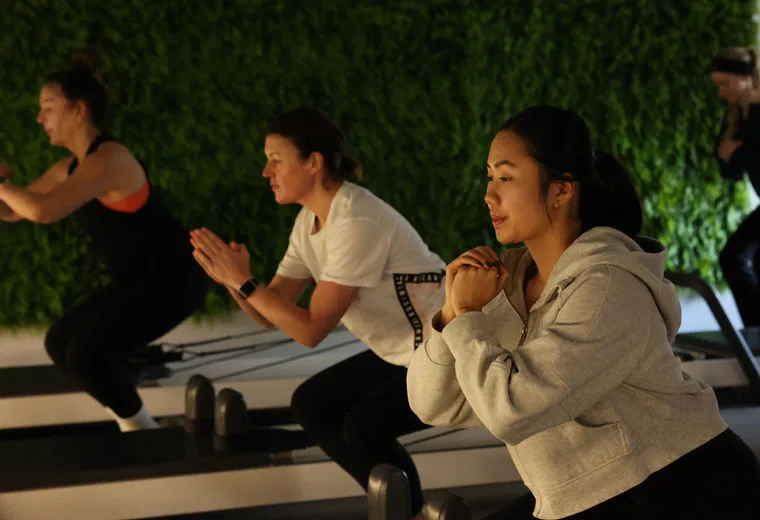
If you have done a few Pilates classes, you have probably been taught to breathe wide into your ribs while keeping your abdominals gently switched on. Then you walk into a yoga class and the teacher asks you to let your belly rise and fall. For a moment it can feel like you are being told the opposite thing.
You are not doing anything wrong in either room. The two practices use breath for slightly different jobs, so they shape it in slightly different ways. Understanding why makes both classes easier, and it gives you a couple of useful breathing tools to use anywhere.
Breath in Pilates, briefly
In Pilates, the breath is closely tied to stability. Most exercises ask your deep abdominal muscles to stay engaged so your spine is supported while your arms and legs move. Breathing into your belly would push against that, so Pilates uses lateral breathing, sending the breath sideways into the ribs instead.
The timing also tends to follow effort. You usually exhale as you push or curl, when your trunk needs the most support. We cover this in more detail in how to breathe in a Pilates class.
Breath in yoga
Yoga has a long history of breathing practices, and modern classes draw on several of them. A few patterns come up in most styles.
Breathing through the nose. Many yoga teachers ask you to breathe in and out through your nose. Nasal breathing tends to slow the breath down and make it more even, which helps keep you steady in longer holds.
Letting the belly move. In seated and lying positions, yoga often encourages a full, relaxed breath where the belly rises on the inhale and falls on the exhale. Since you are not trying to brace your trunk in the same way, there is room for the abdomen to move freely.
Linking breath with movement. In flowing sequences, each movement is matched to an inhale or an exhale. As a general pattern, you inhale as you lengthen or open, and exhale as you fold forward or lower. The breath sets the pace, so the movement never gets ahead of it.
Long, steady exhales. Many teachers cue a slightly longer exhale than inhale, especially towards the end of class. Plenty of people find this helps them settle and switch off.
You do not need to master any of this before your first class. The teacher will cue the breath as you go, usually telling you when to inhale and when to exhale as you move into and out of each position. In longer holds, the cue is often simply to keep breathing slowly through your nose. Follow along as best you can and the pattern becomes familiar within a few classes.
None of this means one practice breathes better than the other. Pilates breathing supports a stable trunk under load. Yoga breathing supports steady holds and relaxation. Learning both gives you more options.
A note on ujjayi breath
In some yoga classes you will hear a breath called ujjayi, sometimes described as ocean breath. You gently narrow the back of your throat as you breathe through your nose, which makes a steady sound you can hear on both the inhale and the exhale. The sound gives you something to listen to and makes it easier to keep the breath slow and even.
If ujjayi feels strained, or makes you feel short of air, simply go back to normal nose breathing. It should never feel forced.
Three simple practices to try
These gentle practices suit most people and take only a few minutes. Practise sitting comfortably or lying on your back with your knees bent.
Belly breathing. Place one hand on your chest and one on your belly. Breathe in through your nose and let the hand on your belly rise, while the hand on your chest stays fairly still. Breathe out through your nose and feel the belly fall. Continue for a minute or two, keeping the breath easy.
Counted breath. Breathe in through your nose for a count of four. Breathe out for a count of six. If that feels too long, shorten both counts. Keep the counts comfortable and stop if you feel light headed. This is a handy one for the minutes before sleep, or while waiting for a stressful appointment.
Moving with the breath. Sit tall on a chair. Breathe in and reach both arms overhead. Breathe out and lower them by your sides. Repeat eight to ten times, letting each movement last exactly as long as the breath. It is a small taste of how a yoga class links breath and movement.
Common mistakes
A few habits trip people up when they start paying attention to the breath.
- Trying too hard. Forcing big, deep breaths can leave you dizzy. A comfortable breath, slightly slower than usual, is plenty.
- Holding the breath in hard poses. If a position is so challenging that your breath stops, ease off until you can breathe steadily again.
- Chasing perfection. Your mind will wander. Noticing that and coming back to the breath is the practice.
- Lifting the shoulders. Some people breathe in by hitching their shoulders up. Let them stay relaxed and let the breath move lower in your body.
Some advanced yoga breathing practices involve holding the breath or breathing very forcefully. These are best learned with an experienced teacher. Check with your GP before trying any breathing practice beyond gentle, normal breaths if you are pregnant or have a heart or lung condition. That includes high blood pressure and asthma.
Using both in your week
The two styles of breathing complement each other well. Pilates breathing becomes useful when lifting the shopping or carrying a child, when your trunk needs support. Yoga breathing becomes useful at the end of a long day or in a stressful moment, when you want to slow down.
Yoga at The Pilates Workshop blends mindful movement with breathwork, and it is one of our six class styles. At the time of writing, classes run on Tuesday evenings at both Wollongong and Shellharbour, but times can change, so check the timetable for the current schedule.
If you have only ever breathed the Pilates way, a Yoga class is a lovely way to try the other side. Come along and let the breath set the pace.